All Projects
Human-Centered Design2026

Refrigerator Flood Protection Concept

Designed the product concept of a fast-deploy waterproof bag that seals around refrigerators to protect them during floods, helping restaurants prevent costly losses. Followed a human-centered approach to create a commercial product that would prepare New York City for a disaster.

Refrigerator Flood Protection Concept

Designing for NYC's next disaster.

Three major disasters hit New York City in the last twenty-five years: 9/11 in 2001, Hurricane Sandy in 2012, and the Covid pandemic in 2019. The class brief asked us to study how the city recovered each time, consider what might hit it in the next twenty years, and design a product, service, or initiative that would help New York recover faster.

Our team of four chose flooding, and narrowed to a single question: what does a flood actually cost a small business, and where in that loss can a product intervene?

Small businesses absorb the shock badly.

Small businesses make up 98 to 99 percent of all business establishments in New York City. They provide local services and jobs, and they have far less capacity than large companies to absorb disaster related losses. Research from the New York Fed reports that 63 percent of small businesses that suffered natural disaster losses had to close temporarily.

Secondary research pointed at a stack of losses that compound each other: lost daily revenue, damaged equipment, destroyed inventory, rising insurance costs, and cleanup expense. Access to capital afterward is the bottleneck on recovery, which meant the most useful intervention would be one that prevents the loss rather than one that helps process it.

Every owner named the same loss.

We interviewed restaurant and bodega owners in flood-prone neighborhoods about their own flood experiences, what they worried about most, and how recovery actually went. Across every conversation the biggest concern was the same: protecting goods, because that is where the money is.

One owner replaced a sixteen year old refrigerator after Sandy and described "thousands of dollars of food had to be thrown out … from the fridge, the freezers." Another said flatly, "We had to throw everything out." A third pointed at the uncertainty that makes the loss worse than it needs to be: "We over throw away because we don't know what got contaminated." One bodega owner put the number at over $6,000 in a single event.

The interviews also killed assumptions. Owners were skeptical of a flood sensor, electrical failure during a flood is exactly when it would stop working. Offsite storage lockers ran into the problem of moving inventory at all: there is no time, no staff, and in a tight city kitchen nowhere to move a 500 lb unit to.

Contaminated water, dead power, forced disposal.

Food service small businesses in flood-prone areas experience significant inventory loss when flooding disrupts critical storage conditions. Perishable goods are compromised by exposure to contaminated floodwater and by loss of refrigeration from electrical disruption. These factors lead to rapid spoilage and forced disposal, creating immediate financial strain and making it difficult for businesses to recover operations in the aftermath of a flood.

That framing set the target: protect the refrigeration unit in place, keep it powered, and do it inside the short window between a flash flood warning and water in the room.

A waterproof bag that goes around the fridge, not the food.

We evaluated four concepts with stakeholders — shared refrigerated storage lockers, a flood monitoring sensor, a financial recovery platform, and a waterproof bag for refrigerators. The bag won on the criterion owners cared about: it does not ask them to move anything. As one put it, it is more convenient to put a bag over everything than to transfer it to a different location.

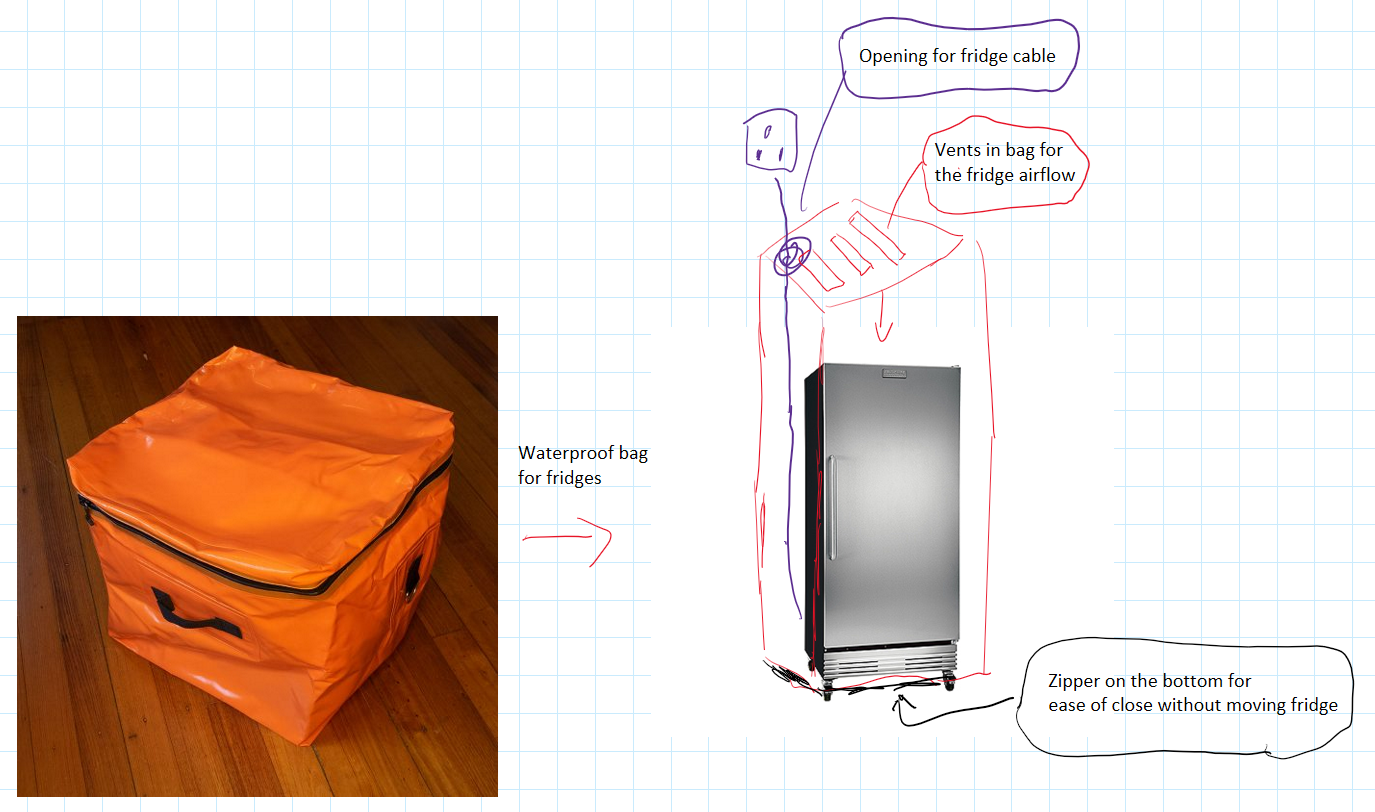
The early sketches worked out the hard parts. A zipper at the bottom would have required lifting the unit, so the zipper moved to the top. The bag is cut significantly oversized so it can be slid under and pulled up rather than fitted precisely. A cable opening at the top keeps the power connection above the water line, and vents in the wall let the compressor breathe.

Stakeholders ranked the four concepts on a single spectrum, from "cool idea, not relevant" to "could help protect business"

What three rounds of feedback changed.

We moved the concept into SolidWorks, then used Vizcom, Figma Make, and Midjourney to test how the product would read — fabric, color, branding, and form. Each round went back to stakeholders and came back with a specific change.

A ventilation chimney was added inside the bag so warm air from the compressor can rise and exit through mesh at the top and sides instead of pooling as heat and condensation. The base layer became low-friction so one person can work it under a loaded unit. The cable port was specified to route to an elevated outlet or a portable generator, because owners raised power loss as often as they raised water. And the product was split into three sizes, since freezers and reach-ins vary enough that a single bag would fit almost nobody.

First pass concept sketch: top zipper, cable port, wall vents

Folded on the shelf. Sealed around the unit.

The bag folds flat and straps into a bundle small enough to store on top of or beside the refrigerator, which matters in kitchens where there is no spare floor space. Deployed, the vent stack sits near the top panel and the cable exits through a sealed port above it.

Folded and strapped, deployed front, deployed rear with vent and cable

Warning to sealed in under ten minutes.

The deployment sequence is the whole product. A flash flood alert arrives, the folded bag comes off the shelf, the low-friction base slides under the unit with a slight tilt, the sides are pulled up and wrapped, the power cable is rerouted through the top port to an elevated outlet or generator, the top zipper is sealed. The vents keep air moving, and the refrigerator keeps running with everything below it dry.

Six step deployment, from flood warning to fully sealed unit

Why not an existing flood bag.

The closest product on the market is the Krisis flood bag, built for general furniture and home goods. It has a good watertight seal for dry inventory, but it requires lifting items into it, it has no tall sizes for refrigerators, and a sealed dry bag cannot hold a running appliance.

FroZone is specific to commercial refrigeration: oversized fit and low-friction base for slide under deployment, mesh venting and a chimney for airflow, and a top cable port so the electrical connection stays out of the water. Against sandbags and perimeter barriers the difference is scope, those defend a building, this defends the one asset that turns a wet floor into a five figure loss.

Class favorite of fifteen teams.

We presented weekly to a class of 120 students and pitched the final concept to a panel of judges from the NYC Preparedness and Recovery Institute. Out of fifteen teams, FroZone took class favorite on combined peer grading and judge ranking.

The lasting lesson was how much of the final product came from conversations rather than from CAD. The top zipper, the chimney, the low-friction base, the generator connection, the size range: none of those were in the first sketch. Each one exists because an owner explained why the previous version would not work in their kitchen.

Final summary board: system, sizing, and deployment. Open full size

The Class Favorite, Spring 2026.

Class favorite, Human Centered Design & Innovation, "Disasters in NYC," Columbia University